 1ºc,
Cloudy
1ºc,
Cloudy  Monday, 21st September, 2026
Allergy-Friendly Upholstery Cleaning: What Actually Helps
Upholstery cleaning for allergy sufferers in Zürich: which fabrics, products, and methods actually help. Free quote: call or WhatsApp +41 76 413 61 83.
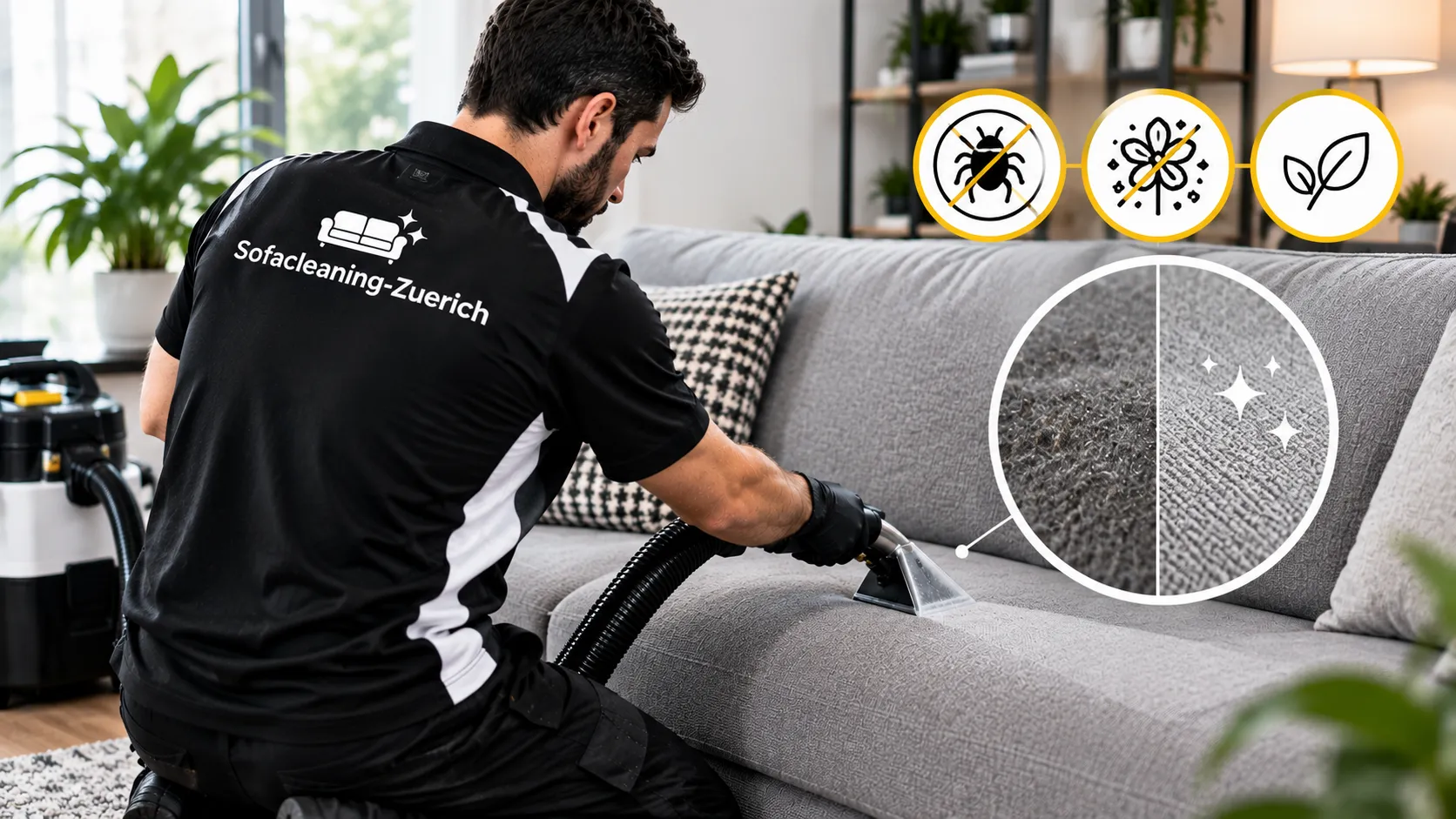
An adult with a longstanding dust and pollen sensitivity moved into a flat in Kreis 6, Oberstrass, and asked us whether to reupholster the existing fabric sofa or have it professionally cleaned first. We recommended a professional clean and fragrance-free products as the first step, since a full reupholster is a much bigger cost that often isn't necessary.
Allergy sufferers ask us about more than just cleaning frequency or dust mites specifically. Our upholstery cleaning service also gets questions about which fabrics are easier to live with, which cleaning products won't leave irritating residue, and how cleaning fits into a broader routine.
This guide covers the practical side of upholstery for allergy-prone households: fabric choice, product choice, and how professional cleaning fits alongside other steps. Results always depend on the material, age, and level of soiling of the upholstered item, and cleaning demonstrably reduces dust mites and allergens rather than treating any medical condition.
|
For allergy sufferers, leather and faux leather are easiest to live with since they have no pile for allergens to embed in and wipe clean easily. Tightly woven fabrics like microfiber are the next best choice. Fragrance-free products avoid residue that can bother sensitive individuals, and regular professional cleaning demonstrably reduces dust mites and allergens. |
Which Upholstery Materials Are Easiest for Allergy Sufferers
Leather and faux leather are generally the easiest upholstery materials for allergy-prone households, since their smooth, non-porous surface has no pile for dust, pet dander, or pollen to settle into, and it wipes clean easily with a damp cloth.
If fabric is preferred, tightly woven materials such as microfiber or performance polyester blends are the next best choice, since their dense weave gives dust mites and other particles less space to embed compared with looser or textured weaves.

A named entity worth knowing here is weave density, how tightly a fabric's fibres are packed together, which affects how easily dust, skin cells, and allergens work their way into the material versus staying closer to the surface where cleaning reaches them more easily.
Neither leather nor tightly woven fabric makes a household allergen-free on its own. Both still need regular cleaning, since dust, skin cells, and pet dander settle on any surface over time, just less deeply than on a loose or textured weave.
Fabric Options for Allergy-Prone Households
|
Material |
Allergen Build-Up Risk |
Practical Note |
|
Leather / faux leather |
Very low (no pile, wipes clean) |
Best default for allergy-focused households |
|
Microfiber / tight-weave synthetic |
Low to moderate |
Strong second choice, still needs regular cleaning |
|
Cotton / linen blends |
Moderate |
Reasonable with a consistent cleaning schedule |
|
Bouclé / velvet / chenille |
Higher (more surface area, looped pile) |
Best reserved for lower-contact pieces |
What About Bouclé, Velvet, and Other Textured Fabrics
Bouclé, velvet, chenille, and other deep-pile or looped textures look and feel wonderful, but their raised structure gives allergens more surface area and more places to settle than a flat weave, making them a less practical everyday choice for allergy-sensitive households.
This does not mean these fabrics are off-limits entirely. A household without daily allergy symptoms may simply accept a shorter cleaning interval, while a household managing more significant sensitivity may prefer to reserve textured fabrics for lower-contact pieces like a decorative armchair rather than the primary daily-use sofa.
For the resident in Kreis 6, Oberstrass, keeping the existing tightly woven fabric sofa and cleaning it professionally made more practical sense than replacing it, since the fabric itself was already a reasonable, allergy-friendly choice.
When buying new upholstery specifically with allergies in mind, asking to see and touch a fabric sample before committing is worthwhile, since weave tightness and pile height are easier to judge in person than from a product photo.
Why Fragrance-Free, Biodegradable Products Matter Too
Fragrance-free, biodegradable cleaning agents avoid leaving behind synthetic fragrance or harsh chemical residue that some sensitive individuals find bothersome on skin contact or through the air, separate from any dust mite or allergen reduction the cleaning itself achieves.
We use eco-friendly, biodegradable cleaning agents as standard, which also tend to be simpler formulations with fewer added fragrances or dyes than some conventional household cleaning products.
If you have a known sensitivity to a specific ingredient or fragrance type, mention it when booking, so the technician can confirm which products will be used on your sofa in advance.
Reading a product's ingredient list is not always practical for a homeowner, which is why asking a cleaning company directly what they use, and why, is a reasonable and normal question to ask before booking.
|
Fragrance-free products avoid residue that can bother sensitive individuals, separate from any dust mite or allergen reduction the cleaning itself achieves. |
Matching the Cleaning Method to Your Fabric
Hot steam penetrates deep into the fibres and noticeably reduces dust mites and bacteria, without harsh chemicals, making it a strong option for allergy-focused households on fabrics that tolerate the moisture well.
For more delicate or textured fabrics, spray extraction or dry foam cleaning can still meaningfully reduce surface-level and near-surface allergen buildup, even though they do not reach quite as deep as steam.
The right method depends on your specific fabric and how significant the household's sensitivity is, which is exactly the kind of decision worth discussing during a free assessment rather than guessing.
This is also where fabric and method intersect: a tightly woven, sturdy fabric can usually take a fuller steam clean, while a delicate or textured material may need a gentler approach even if it means slightly less depth of clean.
A Combined Routine: Cleaning, Ventilation, and Air Quality
Vacuum weekly with a HEPA-filtered upholstery attachment, since this captures fine particles rather than redistributing them the way a non-HEPA vacuum can. Keep the room around the sofa well ventilated, since dust mites multiply fastest above roughly 50 percent indoor humidity.
A HEPA air purifier running in the same room can help capture airborne particles disturbed when sitting down or vacuuming, though it does not remove allergens already embedded in the sofa itself.
Wash removable cushion covers and any sofa throws regularly in hot water, and avoid piling excess soft cushions or blankets on the sofa that are rarely washed, since these add more surfaces for allergens to collect on.
How Often to Clean, and When to See a Doctor Instead
Book professional cleaning every 6 to 12 months if your household includes allergy sensitivity, children, or pets, since this is the step that reaches allergens embedded deep in the fibres that home vacuuming and air purifiers cannot access.
We never claim that professional cleaning cures allergies or replaces medical advice. What steam cleaning and spray extraction demonstrably do is reduce dust mites and allergens present in the fabric at the time of cleaning, as one practical part of a broader routine.
If allergy symptoms persist or worsen despite a reasonable cleaning and maintenance routine, speaking with a doctor or allergist is the appropriate next step, since we are not able to diagnose or treat any medical condition.
|
We never claim that professional cleaning cures allergies or replaces medical advice. If symptoms persist, speaking with a doctor or allergist is the appropriate next step. |
Sofacleaning-Zuerich Offers Allergy-Conscious Cleaning Across Zürich
Sofacleaning-Zuerich serves you directly at home or at the office across Zürich and the surrounding area, from Oberstrass and Unterstrass to Wiedikon, Seefeld, and Oerlikon. We use eco-friendly, biodegradable, fragrance-free-friendly cleaning agents throughout every appointment.
Whether you're deciding between fabric and leather for a new sofa or want an honest assessment of your existing upholstery, our team is happy to talk through the practical options during a free assessment.
If you have questions about upholstery cleaning for allergy sufferers in Zürich, contact Sofacleaning-Zuerich for a free assessment.
Conclusion
For allergy-prone households, fabric choice, product choice, and a consistent professional cleaning schedule all play a genuine role. Leather and tightly woven fabrics are easier to keep allergen-low, fragrance-free products avoid added irritation, and steam or spray extraction cleaning demonstrably reduces dust mites and allergens already in the fabric.
Prices and results are estimates, depending on material and level of soiling, and are confirmed after a brief assessment or on-site visit. If you have questions about upholstery cleaning for allergy sufferers in Zürich, contact Sofacleaning-Zuerich for a free assessment.
|
Sofacleaning-Zuerich serves you across Zürich and the surrounding area. Call or message us on WhatsApp: +41 76 413 61 83. Free quote. |
Frequently Asked Questions
How much does allergy-focused upholstery cleaning cost in Zürich?
Allergy-focused cleaning uses the same steam or spray extraction process as a standard deep clean, starting from approx. CHF 150 for a sofa, since fragrance-free products don't change the base price. The exact price depends on size, fabric, and soiling level, confirmed after a short, free assessment.
Which upholstery fabric is best for allergy sufferers?
Leather and faux leather are generally easiest, since their smooth surface has no pile for allergens to settle into and wipes clean easily. Tightly woven fabrics like microfiber are the next best choice. Bouclé, velvet, and other deep-pile textures collect more allergens and need more frequent cleaning.
How does professional cleaning actually help allergy sufferers?
Steam or spray extraction reaches deep into the fibres to remove dust mites, skin cells, and allergen buildup that home vacuuming cannot reach, using fragrance-free, biodegradable products that avoid added irritation. This demonstrably reduces allergens present in the fabric, though it does not replace medical care.
Does Sofacleaning-Zuerich use fragrance-free products across Zürich?
Yes, we use eco-friendly, biodegradable cleaning agents as standard across every appointment in Zürich and the surrounding area, including Oberstrass, Unterstrass, Wiedikon, and Seefeld. Mention any specific sensitivity when booking so the technician can confirm exactly which products will be used on your sofa in advance.
What should I do if allergy symptoms persist despite regular cleaning?
Continue a reasonable maintenance routine of HEPA vacuuming, ventilation, and professional cleaning every 6 to 12 months, but speak with a doctor or allergist if symptoms persist or worsen. We can reduce dust mites and allergens in your upholstery, but we cannot diagnose or treat a medical condition.